





Skip to content
Know Your GoDIGEXIN® by NXT-USA

Do You 
Know Your Go?

How long does food actually take to move through you?

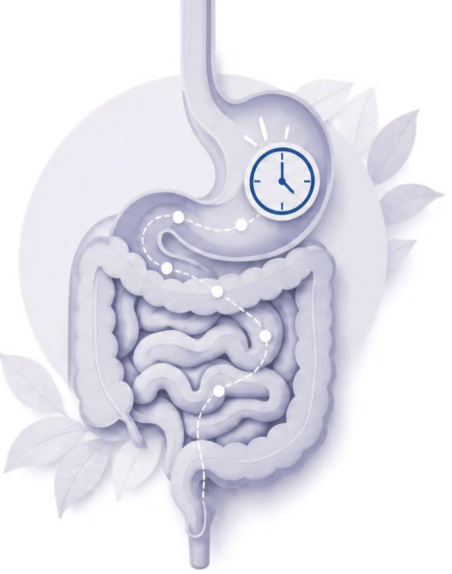
Illustration of the digestive tract with a clock over the stomach and a dotted path showing food moving through the intestines

40%

of people experience digestive distress on a daily basis.

40% of people experience digestive distress on a daily basis, despite decades of being promised digestive relief in the form of probiotics, fibers, and even laxatives. Digestive function, including the stomach, intestines, and bowel, is vital for the breakdown and movement of food through the body, resulting in normal, healthy, comfortable digestion.

Although some consumers have found relief, many struggle to find solutions for their constipation, bloating, discomfort, and irregularity. It’s time to shift the focus back to the digestive outcomes people want.

The category has focused primarily on gut composition rather than gut function. We talk a lot about what’s in the gut—fiber, probiotics, prebiotics, and the microbiome. Yet nearly half the people struggling with digestive issues are just resigned to being uncomfortable. Current approaches leave many consumers feeling like they are without options.

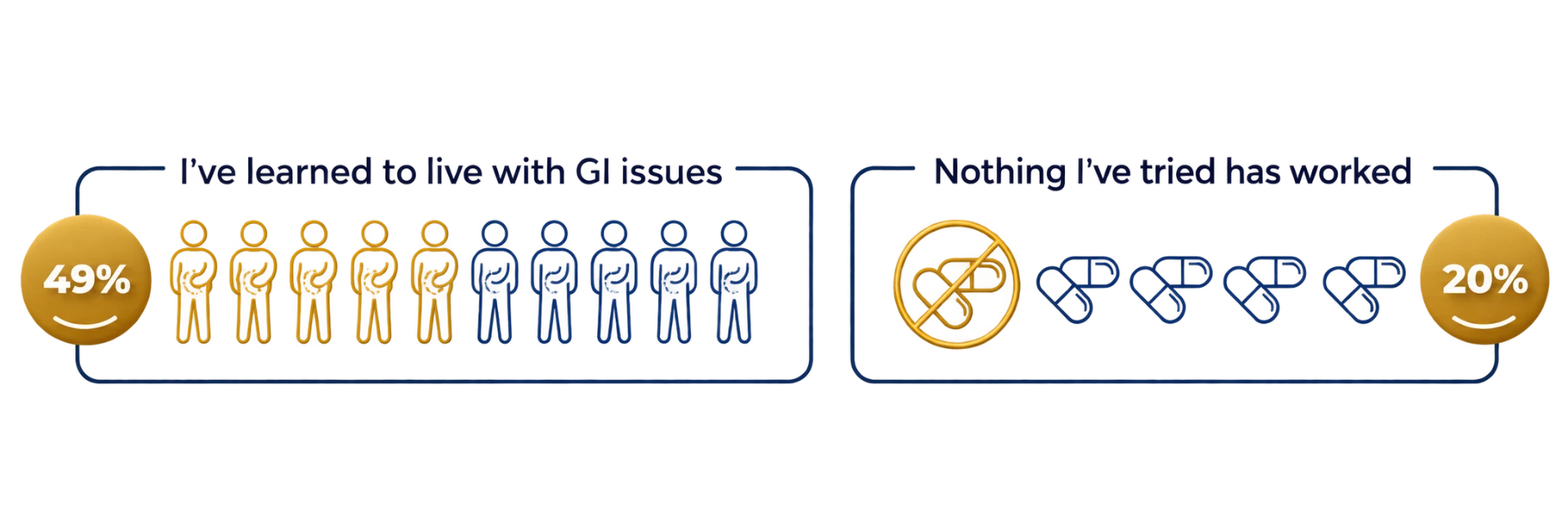
49% of people say they’ve learned to live with GI issues; 20% say nothing they’ve tried has worked

That’s because there’s another essential part of healthy digestion:

MOVEMENT.

How efficiently food moves through your digestive system can influence regularity, bloating, comfort, and how you feel day to day.

Know Your Go puts movement back into the gut-health conversation.

Discover your digestive pattern—and how well you know your go.

01 — The outcome

Good Digestion Is a Smooth Operator.

You shouldn’t have to spend your day thinking about your digestion.

A healthy digestive system processes food, moves it through the GI tract, absorbs nutrients and eliminates waste efficiently and comfortably. When that process gets out of rhythm, the result can be occasional constipation, bloating, gas, and discomfort.

The goal?

“My digestion just works.”
  • Comfortable Digestion
  • Minimal Bloating & Gas
  • Predictable Regularity
  • Complete Evacuation

02 — The mechanism

Meet Peristalsis.

Great name for a band. Even better for digestion.

Peristalsis is the coordinated wave of muscle contractions that helps move food through your digestive tract.

When digestive transit slows, occasional constipation, bloating, and discomfort can follow.

Coordinated contraction → forward movement

In other words

Good digestion isn’t only about what’s in your gut. It’s also about how well things move through it.

03 — Checkpoint

So...What’s Your Go Time?

GI Transit Time is simply the time it takes material to move through the digestive system. People vary, and transit time by itself isn’t a diagnosis or a complete measure of digestive health.

Understanding your normal digestive patterns gives you another way to pay attention to how your digestive system is functioning.

That’s why we say:

Know Your Go.

04 — The fundamentals

Before Supplements, Start Here.

The fundamentals aren’t flashy. They work.

It starts with real food

Your gut appreciates food that still looks like food. Build meals around fruits, vegetables, whole grains, legumes, nuts, and other minimally processed choices. Research in American adults found that greater ultra-processed food intake was associated with higher odds of constipation, while greater minimally processed food intake was associated with lower odds. So, are ultra-processed foods convenient? Absolutely. Your digestive system’s best friend? Maybe not.

Source: pubmed.ncbi.nlm.nih.gov (opens in a new tab)

Eat a fiber-rich diet

Fiber helps keep things moving while also providing fuel for beneficial gut microbes. Good sources include whole grains, beans and lentils, fruits, vegetables, and nuts. Most importantly, don’t go from fiber zero to fiber hero overnight. Increase your intake gradually so your digestive system has time to adjust—and pair that extra fiber with adequate fluids. Your gut generally prefers evolution to revolution.

Source: niddk.nih.gov (opens in a new tab)

Hydrate

Water doesn’t get much marketing hype, but digestion needs it. Adequate fluids help fiber do its job and support softer, easier-to-pass stools. As you increase fiber, paying attention to hydration becomes especially important. Water is an obvious choice, but other fluids and water-rich foods contribute, too. Think of hydration and fiber as teammates: loading up on one while ignoring the other isn’t necessarily the recipe for smooth sailing.

Source: niddk.nih.gov (opens in a new tab)

Move your body

Your body was built to move—and your gut may appreciate it, too. Walking, cycling, swimming, strength training, or simply spending less of the day sitting can support overall health. Research has also linked higher levels of physical activity with a lower risk of constipation, although the evidence for exercise as a specific constipation treatment isn’t completely settled. Bottom line: move because it’s good for you. Your gut may come along for the ride.

Source: pubmed.ncbi.nlm.nih.gov (opens in a new tab)

Start with the basics. Give them time. Pay attention to what changes.

05 — Next level

Still Not Going Like You’d Like?

Lifestyle comes first. But sometimes people want additional digestive support.

When considering a supplement, look beyond what’s in the product and ask what it’s designed to do.

Does it support:

GI Transit • Barrier Function • Gut Signaling • Microbiome Engagement?

Learn about Digestive Performance
01

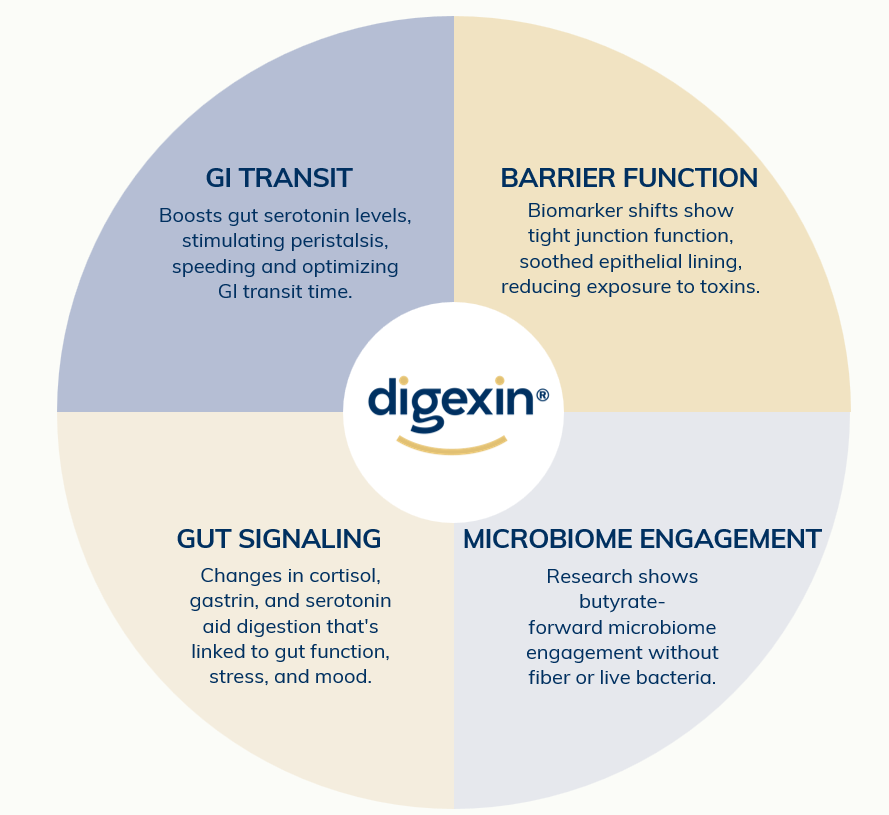
GI Transit

How efficiently food moves through the digestive tract. When transit slows, constipation, bloating and discomfort can follow.

02

Barrier Function

The intestinal lining helps absorb nutrients while maintaining a protective barrier between the gut and the body.

03

Gut Signaling

Two-way talk between the gut and brain helps coordinate digestive movement and response to stress and distress like indigestion.

04

Microbiome Engagement

Gut microbes change compounds we can’t fully digest into metabolites like short-chain fatty acids, including butyrate.

Together: Digestive Performance

Digexin®

Want a Little Help With Your Go?

One ingredient to know: Digexin®

Digexin is a botanical combination of okra fruit extract + ashwagandha root extract that has been clinically studied for digestive function.

Research has evaluated its effects across multiple aspects of Digestive Performance, including GI transit, gut signaling, barrier function, and microbiome engagement.

See the research (opens in a new tab)
Digexin Digestive Performance wheel showing four areas: GI transit, barrier function, gut signaling and microbiome engagement

The Know Your Go Challenge

Ready to take the Know Your Go Challenge?

Use the Blue Poo Test to really know your go time.

The Blue Poo Test is a simple way to estimate your GI Transit Time—clocking how long it takes for food to travel through your digestive system.

The test isn’t complicated and you can try it at home. Are you a baker? Try baking muffins dyed with blue food coloring (recipe below). What you’re looking for is something that you’ll notice when it passes—and it’s hard to miss when your poop is blue or blue-green. Eat the food dyed blue and start your timer. Check each bowel movement over the next few days and you should see the results of your efforts. Chart the time it took to move from your gums to your bum and that’s your estimated GI Transit Time.

See it.
Track it.
Compare it.

Learn about your digestive transit time. Track your normal pattern. Make changes to support your digestive health. Then see what happens.

Take the challenge

Recipe

Blue Vanilla Muffins

Makes
6 muffins
Test serving
2 muffins
Oven temperature
350°F

Ingredients

  • 1 cup all-purpose flour
  • ⅓ cup granulated sugar
  • 1 teaspoon baking powder
  • ⅛ teaspoon salt
  • ½ cup plain oat milk
  • ¼ cup plain coconut yogurt
  • ¼ cup canola oil
  • 1 teaspoon vanilla extract
  • 1 tablespoon McCormick blue liquid food coloring*

*Use the specified blue liquid food coloring. Other brands, gels, powders, and natural colors may perform differently and should not be substituted in this recipe.

Directions

  1. 1

    Heat the oven to 350°F. Place paper liners in six cups of a standard muffin pan.

  2. 2

    In a bowl, stir together the flour, sugar, baking powder, and salt.

  3. 3

    In a separate bowl, whisk the oat milk, yogurt, oil, vanilla, and blue coloring until evenly combined.

  4. 4

    Pour the wet ingredients into the dry ingredients. Stir just until no dry flour remains.

  5. 5

    Divide the batter evenly among the six muffin cups so each muffin contains approximately the same amount of coloring.

  6. 6

    Bake for approximately 18–22 minutes, until the tops spring back lightly and a toothpick inserted into the center comes out without wet batter.

  7. 7

    Let the muffins cool before eating.

Allergen note: This recipe contains wheat. Check every ingredient label for other allergens relevant to you.

Step by step

Take the Transit Check

  1. 1

    Choose your morning.

    Eat two muffins together at breakfast. Record the date and time you finish.

  2. 2

    Carry on with your usual routine.

    Avoid additional blue-colored muffins or other blue-dyed foods while tracking.

  3. 3

    Watch for the first blue.

    Check each bowel movement for a noticeable blue or blue-green color. Record the date and time of the first one.

  4. 4

    Count the hours.

    Subtract your muffin finish time from the time of your first blue-colored bowel movement.

Example

Finish your muffins Monday at 8 a.m. and see your first blue-colored bowel movement Tuesday at 2 p.m.? Your estimated transit time is 30 hours.

What Does Your Result Mean?

One observation, not a grade
Your result is one observation, not a grade. Faster isn’t automatically better, and one transit check cannot tell you whether your gut is healthy.
Color not detected
If you don’t see a clear color change, record the result as “color not detected.” You cannot calculate a reliable transit estimate from that attempt.
Repeating the activity
If you repeat the activity, wait until your stool has returned to its usual color. Use the same recipe, coloring, serving size, and similar timing to make the observations easier to compare.
Safety first
Skip this activity if you have an allergy or sensitivity to any ingredient or food coloring. If you have persistent digestive symptoms, discuss them with a healthcare professional.

Want to geek out on the science?

The Blue Poo method has been studied in published research as a simple, inexpensive way to estimate whole-gut transit time. The researchers found that gut transit time is meaningfully related to the gut microbiome and noted that GI transit is an important, often overlooked aspect of gut health. That’s what we’re talking about!

Read the published research (opens in a new tab)

Disclaimer: The Know Your Go Challenge is an educational awareness activity and is not intended to diagnose, prevent, treat, or diagnose any medical condition.

Think. Track. Improve.

Better digestion starts with paying attention.

Eat well. Get enough fiber. Stay hydrated. Move your body. Understand your patterns.

And most importantly:

Know Your Go.

The 30-second quiz

Do You Know Your Go?

Question 1 of 5How often do you usually go?

This quiz is an educational awareness tool and is not intended to diagnose any medical condition.